 中文
中文Theme: Dialogue between Antitrust Legal Analysis and Economic Analysis in the Digital Era
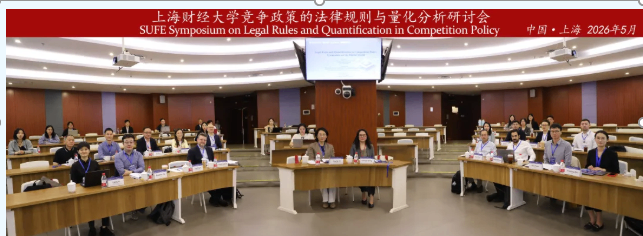
Seminar on Legal Rules and Quantification in Competition Policy was successfully held at the Research and Experiment Building of Shanghai University of Finance and Economics (SUFE).
Sponsored by the Institute of Chinese-Style Modernization, College of Business and Law School of Shanghai University of Finance and Economics, the seminar was jointly undertaken by the Antitrust and Competition Economics Research Center (Incubated), the Center for Competition Law and Intellectual Property of SUFE Law School, and the Centre for Law, Economics and Society of University College London (UCL) Faculty of Laws.
The seminar focused on two core themes: New Antitrust Issues in the Digital Economy and Transformation of Competitive Harm Theories in the Digital Context. Scholars from China and abroad engaged in lively and in-depth academic discussions on these topics.
Opening Remarks
Professor Jin Yuying, Member of the University Party Committee Standing Committee, Vice President of SUFE and Concurrent Dean of the College of Business, and Professor Song Xiaoyan, Dean of SUFE Law School, delivered opening remarks respectively, extending a warm welcome to scholars from home and abroad.
Vice President Jin Yuying noted that digital technology has profoundly reshaped market patterns, breaking down traditional geographical boundaries and leading to a notable trend of market and corporate concentration, while forging new features of global interconnection. At the same time, the interplay of economic, technological and geopolitical factors has posed new and complex challenges to competition policy and business system design. These trends have also raised higher requirements for quantitative economic analysis and institutional research, highlighting the significance of in-depth integration of law and economics. She expected participating scholars to share research achievements and exchange methodological insights, promote international collaborative research and talent training, and advance the development of relevant fields through interdisciplinary, cross-institutional and cross-jurisdictional collaboration. She also wished the seminar a great success.
Dean Song Xiaoyan pointed out that global digital economy competition is now at a critical juncture, where data sovereignty and technological barriers are reshaping the international competition landscape. Traditional theories of competitive harm are facing severe challenges. Against this backdrop, the seminar featuring a dialogue between legal rules and quantitative analysis in competition policy is particularly timely, and she looked forward to the valuable insights shared by participating experts.
Part 1: Antitrust in the Digital Economy
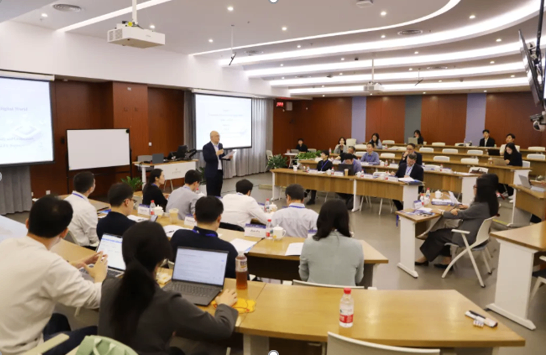
The first session centered on new antitrust issues in the digital economy, chaired by Associate Professor Ju Heng, Director of the Antitrust and Competition Economics Research Center and faculty member of SUFE College of Business.
Professor Ioannis Lianos, Fellow of the Academy of Social Sciences and faculty member of UCL Faculty of Laws, delivered a speech entitled Reshaping Regulatory Interactions Between Competition Law and Intellectual Property Law in the Digital Business Ecosystem. He pointed out that traditional exclusivity-centered intellectual property law has inherent limitations in an open innovation ecosystem, and creatively proposed tokenized access rights to facilitate knowledge sharing and innovation.
Professor Li Lingfang from Fudan University School of Management focused on monopoly risks of artificial intelligence and regulatory responses. She argued that the AI sector faces not only structural risks arising from excessive concentration of production factors, but also behavioral monopoly risks such as algorithmic collusion and data discrimination at the application level. On the basis of reviewing a large number of global cases and relevant literature, she put forward targeted regulatory suggestions.
Associate Professor Tao Xuezhen from SUFE College of Business discussed the dual impacts of open-source AI models on market competition patterns as well as cross-border governance dilemmas, and proposed a framework to balance technological competition and overall social welfare.
Associate Professor Li Liang from the School of Foreign-related Legal Studies, China University of Political Science and Law, analyzed the causes and regulatory logic of China’s "involution-style" competition in the digital age. He stressed that the existing antitrust rules are sufficient to govern most market behaviors falling into the category of involution-style competition. In the regulation process, the boundary of competitive behaviors should be clearly defined to avoid excessive market intervention.
Professor Xu Li from Antai College of Economics and Management, Shanghai Jiao Tong University; Associate Professor Zhai Wei, Executive Director of the Competition Law Research Center at East China University of Political Science and Law; Associate Professor Yuan Bo, Executive Director of the Center for Competition Law and Intellectual Property of SUFE Law School, served as discussants and shared in-depth insights into the above presentations.
Part 2: Evolution of Competition Harm Theory in the Digital Context
The second session focused on the evolution of competition harm theory in the digital context, chaired by Wu Qingqing from SUFE Law School.
Professor Chen Zhiqi from Carleton University analyzed privacy protection from three dimensions: free market, market competition and government regulation. He revealed that a free market can protect privacy indirectly, while market competition may intensify excessive data collection and regulation may trigger unintended consequences. His views provide important references for formulating privacy protection regulatory frameworks tailored to the digital economy.
Stavros Makris from UCL Faculty of Laws focused on the evolutionary development of applicable standards for the refusal-to-deal doctrine under antitrust law in typical cases. He pointed out that the doctrine has evolved from an independent case-specific application paradigm to coordinated development among case groups, which further clarifies the applicable standards of the rule in the digital economy.
Yuan Han from SUFE College of Business conducted an empirical analysis on interoperability problems among mainstream domestic software platforms. She found that platforms create user lock-in effects by building closed ecosystems and restricting interoperability, and suggested enhancing two-way interoperability to improve consumer welfare.
Zhu Yingying from SUFE Law School focused on the antitrust regulation of financial data sharing. She held that before the introduction of special regulatory rules for the financial industry, antitrust law can serve as an alternative approach to indirectly restructure the benefit distribution mechanism of the digital financial ecosystem and promote the formulation of industrial regulatory rules.
Associate Professor Fu Xiao from School of Economics, Zhejiang University of Finance and Economics; Researcher Wu Peicheng from Guanghua Law School, Zhejiang University; Yan Xingyu from Xiamen University Law School served as discussants and conducted in-depth exchanges on the above reports.
The third session was chaired by Professor Liu Shuilin from SUFE Law School. Professor Ioannis Lianos and Associate Professor Ju Heng delivered closing remarks and expressed sincere gratitude to all participating scholars. The seminar concluded successfully in a warm and vibrant academic exchange atmosphere.

Seminar on Legal Rules and Quantification in Competition Policy Held Successfully
2026 Seminar on "AI Empowering MBA Curriculum Teaching" for MBA Education Institutions Held at Shanghai University of Finance and Economics
2026 QS EMBA Rankings Released | SUFE COB EMBA Ranks 17th in the Asia-Pacific!
Delegation from the University of St Andrews Business School Visits SUFE COB