 EN
ENA delegation of more than 70 MBA students and faculty from National Economics University (NEU), Vietnam visited our school to participate in an academic symposium themed China–Vietnam business cooperation. Professor Sun Qi, COB Associate Dean, Professor Xu Songwei, Executive Director of the MBA Center, along with faculty and students from the International Cultural Exchange School at Shanghai University of Finance and Economics, received and met with the NEU delegation. The event served as a forum for academic and business exchange between China and Vietnam, with discussions focused on corporate collaboration in areas such as digital transformation, supply chain management and the green economy. It also aimed to build a foundation for deeper cooperation in talent development and technological innovation.
At the start of the event, Professor Sun Qi, Associate Dean of the College of Business of Shanghai University of Finance and Economics, extended a warm welcome to the visiting delegation from the National Economics University of Vietnam. He noted that China and Vietnam share a deep-rooted historical bond, as well as strong economic ties, with bilateral trade reaching record highs in recent years. The close economic ties and potential for cooperation between China and Vietnam are inseparable from the intellectual support provided by academia. He pointed out that as one of the first universities in China to launch an MBA program, SUFE has always regarded internationalized management education and the cultivation of business leaders through practical experience as a core part of its talent development mission. This exchange with NEU represents a meaningful opportunity for academic representatives from both countries to explore future avenues of economic cooperation. He expressed hope that both sides would learn from each other, expand their perspectives, and work together to cultivate more globally oriented, interdisciplinary talent.
Professor Ta Van Loi, Dean of the School of Business at the National Economics University of Vietnam, remarked that Vietnam is currently accelerating its efforts in technological innovation and national digital transformation. China’s practical experience in digital transformation and green finance offers valuable insights for Vietnam to learn from. As one of the country’s top institutions in economics, NEU has long been committed to international business education. During this visit, he expressed the hope to engage in discussions and research with College of Business of Shanghai University of Finance and Economics on topics such as managing risks in overseas expansion and optimizing cross-border supply chains—aiming to deliver solutions that are both theoretically sound and practically applicable, while also deepening cooperation to strengthen the foundation for talent development.
During the case study session, Wang Xiaofang, an MBA student from the College of Business of SUFE, opened with an analysis of China’s industrial innovation and its overseas expansion strategies. She offered an in-depth analysis of how Chinese enterprises have achieved breakthroughs in international markets and the lessons these practices may offer for China–Vietnam collaboration. She highlighted that China’s overseas expansion has been powered by several key factors: the adoption of digital and intelligent technologies, a strong focus on market and customer, the ongoing refinement of business models and support from both policies and global partnerships. Focusing on China–Vietnam cooperation, she advocated for embracing digital transformation and strengthening joint research and development. By tapping into China’s well-established global expansion ecosystem—including logistics, payment systems and other key enablers—China and Vietnam can evolve from supply chain partnerships to building a shared community of innovation. Following her presentation, the first group of MBA students from the National Economics University of Vietnam offered an in-depth analysis of Vietnam’s business environment and cooperation opportunities. The team noted that Vietnam, as a strategic hub in Southeast Asia, is actively integrating into free trade systems. With its youthful population and commitment to digital transformation, the country is showing growth potential in sectors such as manufacturing, electronics and energy. Chinese companies’ strengths in technology development, supply chain integration and the use of digital tools are highly complementary to Vietnam’s strategic location, cost-effective manufacturing and favorable tariff policies.
The second group of MBA students from the National Economics University of Vietnam used SAIC Volkswagen as a case study, offering an in-depth analysis of how its strategic management approach could serve as a reference for Vietnam. For the Vietnamese market, the team recommended drawing on SAIC Volkswagen’s localization strategy by strengthening local R&D, supply chains and talent development in the automotive sector. They also suggested leveraging joint venture models to integrate technological and market resources, while capitalizing on Vietnam’s geographic advantage to expand into the ASEAN market. This would enable a shift from isolated manufacturing operations to full value-chain capabilities, promoting deeper collaboration between Chinese and Vietnamese enterprises in areas such as new energy and smart manufacturing.
The third group of MBA students from the National Economics University of Vietnam conducted an in-depth analysis of SAIC Volkswagen’s management model, distilling three core lessons: transparent governance, localized technology development and the embedding of ESG principles into the company’s core strategy. The team recommended developing carefully managed strategic partnerships to align capital with technology, accelerating the use of digital tools like ERP and AI across the value chain, and creating standardized systems for human resource management. They also emphasized the importance of building structured risk management frameworks and integrating ESG values into corporate governance, paving the way for a shift from traditional manufacturing to a technology-and-service–driven business model.
The fourth group of MBA students from the National Economics University of Vietnam used YTO Express as a case study to highlight lessons in logistics and supply chain management that could benefit Vietnam. The team noted that YTO’s success lies in its seamless integration of logistics infrastructure, digital technologies and financial services. For future enterprise development, the team recommended that China and Vietnam deepen cooperation by leveraging Vietnam’s geographic advantages in areas such as cross-border e-commerce logistics, multimodal transport infrastructure and green logistics technologies. They proposed a collaborative development model—“Chinese technology with Vietnamese implementation”—to enhance regional competitiveness in the logistics sector.
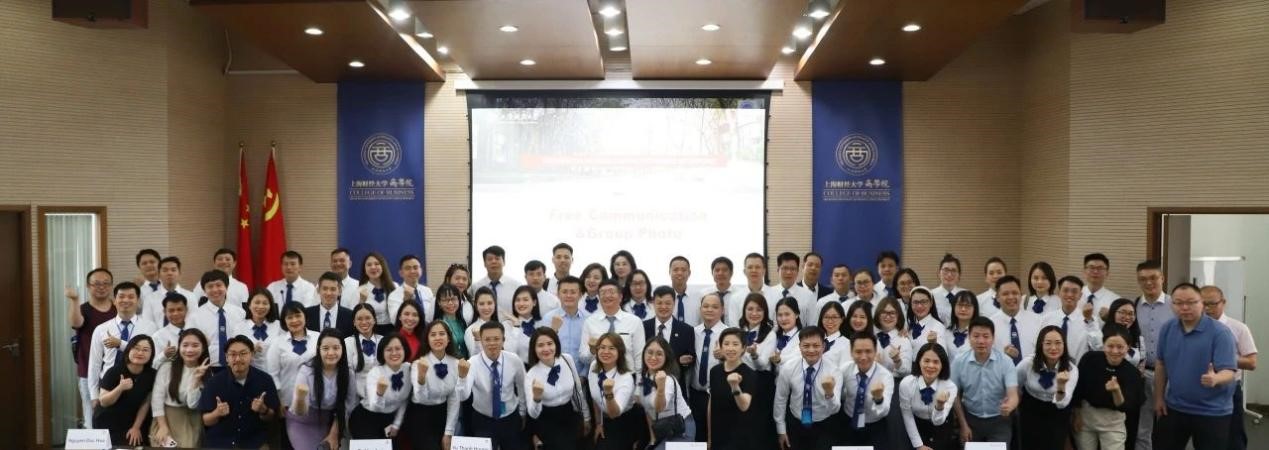
Professor Ta Van Loi, Dean of the School of Business at the National Economics University of Vietnam, delivered closing remarks at the end of the symposium. He emphasized that the economic strengths of China and Vietnam are far more complementary than competitive. This exchange not only deepened insights into bilateral cooperation in academia of China and Vietnam, but also provided a practical channel for enterprises to connect and collaborate. As MBA students grow into decision-makers in the future, the digital strategies, carbon neutrality solutions and localized insights explored today will lay the foundation for shared prosperity across the region. As the Belt and Road Initiative continues to align more closely with the “Two Corridors, One Belt” plan, Chinese and Vietnamese enterprises are expected to find broader opportunities for collaboration in areas such as industrial chain integration and technological innovation. During the event, MBA students from both universities engaged in a dynamic exchange over the case studies presented by each group. The discussion was moderated by Mao Nan, an MBA student from the College of Business of Shanghai University of Finance and Economics.

Congratulations! Jin Yannan from SUFE COB has been awarded funding for a General Program of the National Natural Science Foundation of China (NSFC)
Academic Symposium on Artificial Intelligence Empowering Chinese-Style Modernization Concludes Successfully
The Collision of Chinese and Vietnamese Wisdom: Jointly Exploring the Enterprise's New Voyage—— A Delegation from Vietnam National Economics University Visits SUFE COB
SUFE COB Operation Seminar Concludes Successfully