 EN
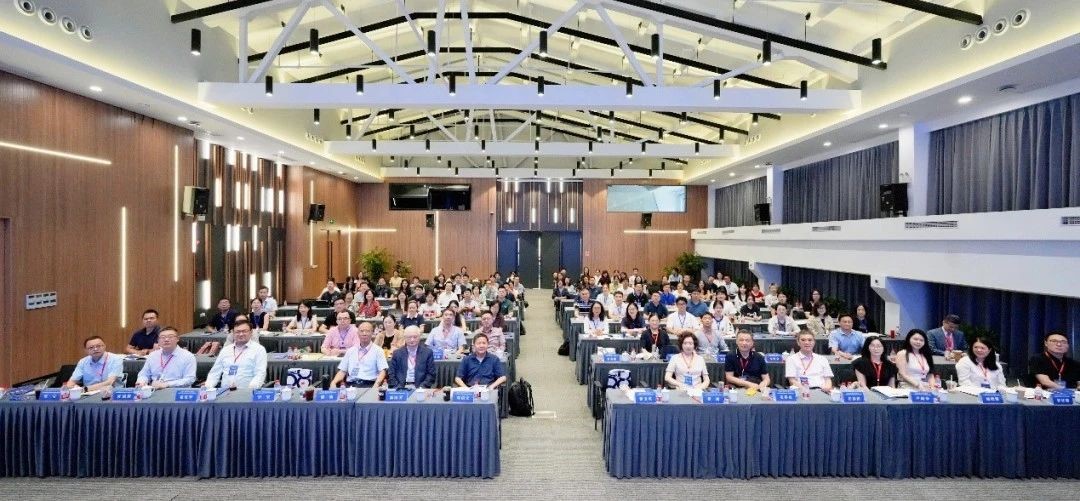
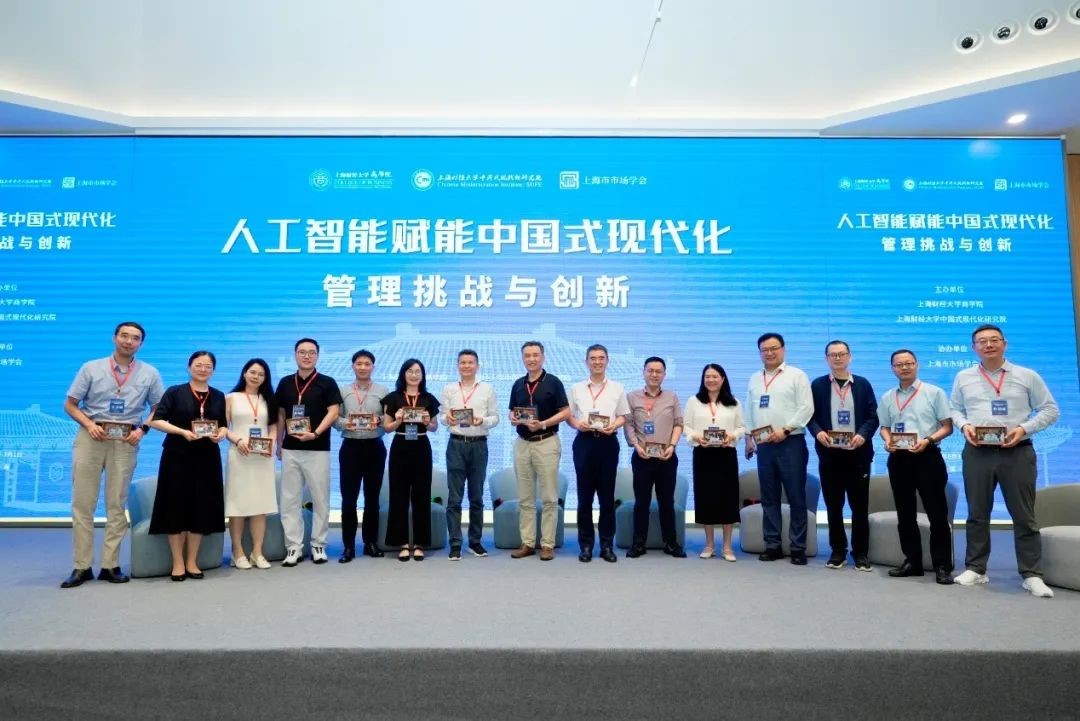
ENArtificial intelligence is transforming the theory and practice of management at an unprecedented pace.Amid this transformation, Chinese scholars are actively exploring solutions tailored to local contexts, contributing original insights to innovation in management around the world.From June 30 to July 1, 2025, the Symposium on AI Empowering China-style Modernization: Managerial Challenges and Innovations was held at the Science and Technology Park of Shanghai University of Finance and Economics. The event was jointly organized by the College of Business and Chinese Modernization Institute of Shanghai University of Finance and Economics, with support from the Shanghai Marketing Association.Experts and scholars from China’s top universities—including Tsinghua University, Peking University, Shanghai Jiao Tong University, Zhejiang University and Fudan University—gathered to explore how management is evolving in the age of artificial intelligence and to contribute insights toward building a management system aligned with China-style modernization.
In her opening remarks, Jin Yuying—Dean of the College of Business—noted that artificial intelligence has evolved from serving purely as a tool for efficiency to becoming a fundamental force reshaping the discipline of management. “Digital Intelligence is breaking down the boundaries of traditional Management Science and driving a deep integration of technology and theory.” she emphasized. Professor Chen Guoqing of Tsinghua University introduced the “Three-Dimensional Framework for Digital Intelligence Transformation.” In response to the challenges posed by a shifting research paradigm, he proposed a methodology of process innovation aimed at reconfiguring the fundamental building blocks of management research. Frontier research on artificial intelligence focuses on two main areas: the inherent limitations of AI technologies—such as black-box, AI hallucinations and data bias—and the potential implications of their underlying value orientations. In particular, Professor Chen highlighted the dual bias in human–machine interaction within AIGC contexts (the model’s self-selectivity and users’ tendency to conform). He emphasized the need to adopt a “sensing–response” framework to guide a new paradigm in management research. Professor Mao Jiye of ShanghaiTech University presented a case study on making the “black box” of management more transparent. In the “Lifelong Service” customer service system, AI reshaped the employee training approach by incorporating affective computing, reducing service error rates. At the refrigerator production line of CIMC Group, the integration of digital twin technology and machine learning revolutionized traditional foaming processes—reducing energy consumption and improving product yield. These cases illustrate that AI’s core value lies in turning opaque management processes into transparent, controllable systems—driving a fundamental shift from experience-based decisions to data-driven decision-making.
Professor Du Yunzhou of Southeast University illuminated the essence of this transformation from the perspective of management philosophy, arguing that AI’s knowledge production operates through a rule-bound combination of empirical induction and abductive reasoning—lacking the conceptual depth and value-driven judgment that only humans can provide. These are essential to breaking through AI’s cognitive limitations. He analyzed the complementary relationship between AI and human cognition, arguing that the uniquely human capacity for value-based reasoning is key to breaking through AI’s cognitive boundaries. Professor Zhu Yi of the University of Minnesota examined the complex influence of AI on consumer behavior. For example, drivers using freight platform expressed both anticipation and apprehension toward AI-powered bargaining bots—a psychological contradiction that reveals a deeper truth: the application of technology must balance greater efficiency with human care.
In the field of innovation and entrepreneurship, AI is rapidly evolving from a supporting tool into a strategic partner. Drawing on case studies from companies such as SANY Group and Midea Group, Professor Cai Li of Jilin University developed the “AI–Entrepreneurial Elements Interaction Model.” This model breaks away from the traditional linear, individual-centered approach to entrepreneurship, revealing how AI reshapes the dynamic relationships among entrepreneurs, opportunities, resources and environments. It offers a new theoretical framework for entrepreneurial practice in the digital economy era.
The field of product development is also experiencing revolutionary breakthroughs. Professor Zeng Fu’e and her team at Wuhan University have developed a spiral evolution model called “Demand Perception–Solution Generation–Supercomputing Validation,” which complements the “AI + IDE” integrated development approach proposed by Professor Xie Kang of Sun Yat-sen University. These innovative approaches have successfully resolved the classic scale–efficiency paradox in complex industrial product development, offering solid momentum for the upgrading of China’s manufacturing sector toward middle to high-end production.
Professor Gao Weihe of Shanghai University of Finance and Economics introduced the “Three-Stage Evolutionary Framework for AIGC Marketing,” which offers a systematic view of how AI is reshaping the business ecosystem. When AI goes beyond optimizing marketing processes to redefining how value is created, its impact on the business ecosystem becomes truly disruptive. The framework marks a paradigm shift from using AIGC as a standalone tool to building an integrated capability system—providing enterprises with a closed-loop roadmap from intelligent content creation to strategic transformation.
AI is driving a comprehensive transformation in organizational management, reshaping everything from structural frameworks to cultural dynamics. Professor Jing Runtian of Shanghai Jiao Tong University noted that AI enables organizations to overcom the limits of human rationality and improve the efficiency of decision-making. Professor Zhou Xinyue of Zhejiang University developed the “Social Intelligence Pyramid,” which systematically illustrates how AI advances from basic task execution to enabling complex emotional interactions. She contributed to the development of the “Heart Mirror” emotion recognition technology, which has overcome key bottlenecks in the field.
Professor Zhang Guanglei of Wuhan University of Technology categorized the roles of AI in the workplace into three types—“colleague,” “competitor” and “boss”—and offered an in-depth analysis of how each role impacts employees’ psychology and behavior. Professor Zhong Weiguo of Peking University introduced the “GAI Model,” which integrates incentive mechanisms with knowledge management systems, providing a theoretical foundation for new forms of human–machine collaborative organizations.
AI technology is also reshaping the methodological landscape of management research. Professor Li Guo of Beijing Institute of Technology applied AI modeling to challenge conventional assumptions about channel strategies. Professor Wu Bao from Zhejiang University of Technology used deep learning algorithms to accurately detect behavioral patterns among retail investors. Professor Jiang Baojun of Washington University in St. Louis, United States introduced AI agents into the classic “Beer Game” and discovered that AI can also exhibit the bullwhip effect—offering a fresh perspective for studying organizational behavior.
Empirical research by Professor Lu Xianghua of Fudan University shows that AI agents capable of realistic interaction can significantly improve users’ ability to stay focused—offering critical evidence to support the development of intelligent services in fields such as education and healthcare.
During the roundtable session, scholars engaged in forward-looking discussions on “AI-powered scenarios ten years from now.” They shared insights from diverse perspectives and proposed imaginative concepts such as enhancing quality of life within the framework of social norms, AI-assisted emotional support and personalized product development. The symposium concluded with a visit to Bilibili, where participants observed a vivid demonstration of how AI technology is being creatively integrated with youth culture. From content creation and community operations to value communication, AI has not only boosted efficiency but has also become a powerful new medium for cultural transmission. This deep integration of technology and the humanities represents a distinctive path of management innovation within the framework of China-style modernization.
This symposium was more than an academic exchange—it was a collision of ideas. As artificial intelligence becomes deeply intertwined with China-style modernization, management innovation has emerged as a key pillar of national strategy. Scholars in attendance agreed that AI is not merely a tool for improving efficiency, but a core driver in modernizing governance systems and capabilities. Looking ahead, future management models will place greater emphasis on human–machine collaboration and cultural empathy, offering Eastern wisdom to guide transformative change in China and around the world.

Congratulations! Jin Yannan from SUFE COB has been awarded funding for a General Program of the National Natural Science Foundation of China (NSFC)
Academic Symposium on Artificial Intelligence Empowering Chinese-Style Modernization Concludes Successfully
The Collision of Chinese and Vietnamese Wisdom: Jointly Exploring the Enterprise's New Voyage—— A Delegation from Vietnam National Economics University Visits SUFE COB
SUFE COB Operation Seminar Concludes Successfully