 EN
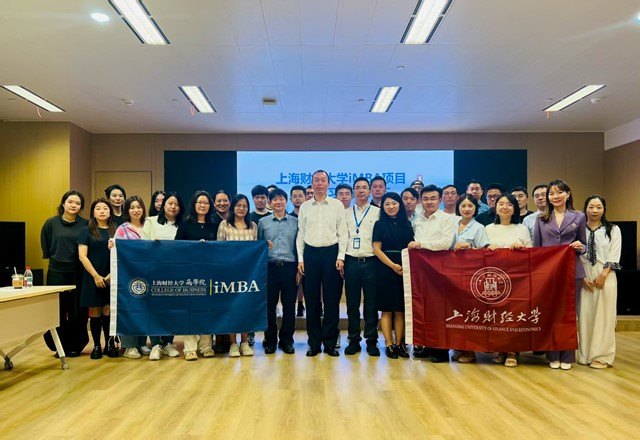
ENProfessor Wenjie Ma, a faculty member of SUFE iMBA and Dean of SUFE Shanghai International Financial Center Research Institute, Ms. Qingfang Hua from SUFE iMBA, and 35 iMBA students and alumni, visited the Cross-Border Interbank Payment System (CIPS) for a learning and exchange session.
Vice President Xuanyang Xie of CIPS attended the exchange meeting. In his welcoming remark, Vice President Xie Xuanyang extended a sincere welcome to the teachers and students. He stated that this exchange initiative brings the latest practices in cross-border payments into the classroom, while also introducing cutting-edge academic theories from the university to the company. He expressed the hope that such collaborations between universities and enterprises would foster mutual growth. Manager Xiao Liu from the Strategy Department of CIPS introduced the construction and business development of the CIPS system. Senior Manager Lei Shi from the Product Department of CIPS presented the development of CIPS' cross-border integrated information service platform.
Professor Wenjie Ma, Dean of SUFE Shanghai International Financial Center Research Institute and faculty member of the iMBA program, elaborated on the development standards of the SIIFC International Financial Center City Index. He explained that the primary indicators are structured around five core dimensions: financial system development, financial reform and opening-up, financial services for the real economy, financial supervision and risk prevention, and financial talent development and business environment optimization.
Specifically, he noted three guiding principles: First, the index draws on established international evaluation frameworks, covering core dimensions such as financial market development, service levels, and degree of internationalization, to ensure global comparability. Second, it aligns with the strategic positioning of Shanghai as an international financial center, integrating national initiatives such as RMB internationalization and the dual circulation strategy and highlighting the unique development path of China's financial system. Third, it serves Shanghai by emphasizing the city's role in financial opening-up and innovation, concentration of headquarters economy, and RMB pricing functions.
Professor Wenjie Ma mentioned that the released SIIFC International Financial Center City Index shows that Shanghai has achieved remarkable results in building an international financial center. From the perspective of financial system construction, Shanghai has developed a comprehensive financial market covering securities, money, foreign exchange, gold, futures, insurance, bills, and carbon trading, and also hosts key financial infrastructure facilities including registration, custody, settlement, and clearing institutions. In addition, it has also demonstrated strong resilience in serving the real economy and strengthening financial supervision and risk prevention.
However, Professor Ma pointed out that Shanghai still faces gaps in financial internationalization and analyzed the issue from the dimensions of investment, financing, market construction, financial institutions, offshore finance, and green finance internationalization. In terms of green finance internationalization, from the perspective of "going global", Shanghai needs to further strengthen support for small and medium-sized enterprises (SMEs) expanding overseas, enhance the international service capabilities of domestic financial institutions, and continuously refine the policy coordination mechanism. From the perspective of "bringing in", Shanghai should further expand the scale of green finance-related products and encourage foreign-funded intermediary service institutions to better integrate into Shanghai’s financial ecosystem, thereby leveraging their comparative advantages more effectively.
This visit to CIPS is of great significance. Teachers and students gained an in-depth understanding of the cutting-edge technologies and internationalization process of financial infrastructure. The exchange with industry professionals broadened participants’ perspectives, inspired innovative thinking, and provided valuable insights for interdisciplinary research between academia and industry. It also helps teachers and students keep pace with the times in their MBA study and practice, and explore new paths for technology-driven innovation.
In the era of digital intelligence, the College and the iMBA Program actively explore the integration and innovation of academic disciplines and practical application, offering MBA students a learning experience aligned with contemporary trends. The College of Business of Shanghai University of Finance and Economics is committed to building a world-class business school with distinctive financial and economic characteristics. The SUFE iMBA Program adheres to the educational philosophy of "Integration of Knowledge and Action, Responsibility to Society", and encourages students to acquire new knowledge by engaging with research institutions and enterprises, so as to promote mutual learning and collaborative exchange.

2026 Overseas Study Tour | AI Empowering New Quality Productive Forces: College of Business MBA/EMBA UK Study Tour Concludes Successfully
2026 SUFE AI + Operations Workshop Successfully Held
SUFE Empirical IO Conference 2026 Successfully Held
Innovation-Led and Capital-Empowered