 EN
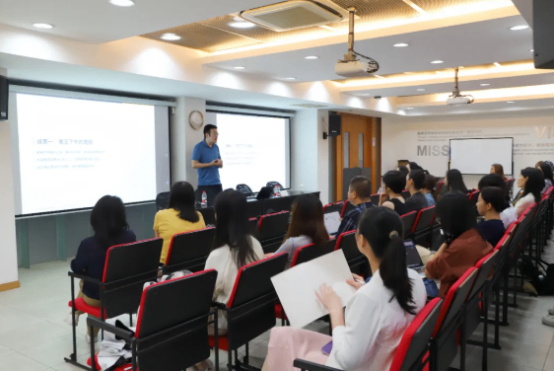
College of Business recently held a seminar on AI applications to implement the national strategy for digital education, accelerate the digital transformation of higher education, and enhance faculty members' AI literacy for teaching and their ability to use digital tools. Liang Zhumei from the Center for Teaching and Learning Development at Shanghai Jiao Tong University and Tao Xuezhen from COB's Department of Industrial Organization were invited to speak on AI-assisted instructional design and practical AI applications in office work, respectively. Ye Weiling, Director of Faculty Development at COB, delivered the concluding remarks.
In her presentation, "AI-Assisted Instructional Design," Liang Zhumei began with the nature of learning and approaches to teaching. Drawing on constructivist learning theory, she emphasized that instructional design should shift classroom practice from "teaching the textbook" to "using the textbook to teach." She focused on backward design, explaining how Bloom's taxonomy of cognitive objectives and the ABCD principles can help define observable, measurable learning objectives. Through live demonstrations, she showed how large language models can assist with drafting learning objectives, generating classroom cases, and designing questions that promote higher-order thinking. Discussing classroom interaction and assessment, she also stressed that AI should support students' deep learning, while teachers must retain responsibility for directing instruction and exercising professional judgment.
Tao Xuezhen's presentation, "Putting AI to Work with WorkBuddy: From Conversation to Delivery in Everyday Office Tasks," addressed practical office needs and explored how AI tools can move beyond content generation to task execution and the delivery of finished work. Using case demonstrations, he introduced WorkBuddy's features and methods of use. Alongside illustrating the potential of AI tools, he emphasized the security boundaries and human review responsibilities involved in their use. He reminded faculty members to set appropriate file access permissions, back up important materials, and rigorously verify the factual accuracy of generated content, the definitions and scope of data, and the quality of the resulting work. His principle, "Leave execution to AI, but keep judgment in your own hands," offered practical guidance for using AI tools responsibly and efficiently.
In her concluding remarks, Ye Weiling, Director of Faculty Development at COB, emphasized that AI should serve human professional judgment and practical needs, whether in instructional design or everyday office work. Echoing Liang's central message, she reminded faculty members that "teachers remain responsible for building networks of knowledge and exercising instructional judgment." She encouraged them to apply backward design rigorously, define observable learning objectives, and shift classroom practice from covering more content to enabling deeper learning. She also urged faculty members to explore appropriate uses of AI tools in teaching and daily work, improving efficiency while upholding professional judgment and quality standards.
By combining AI-assisted instructional design with practical AI applications in office work, the seminar addressed innovation in teaching concepts and methods as well as the practical and responsible use of intelligent tools. It broadened faculty members' perspectives on using AI to support teaching, research, and administrative services. Going forward, COB will continue to focus on strengthening faculty AI literacy and promoting innovation in education through digital and intelligent technologies. The College will further integrate AI into the improvement of instructional design, students' deep learning, and the quality and efficiency of everyday work, using these technologies to support faculty development and high-quality student education.