 EN
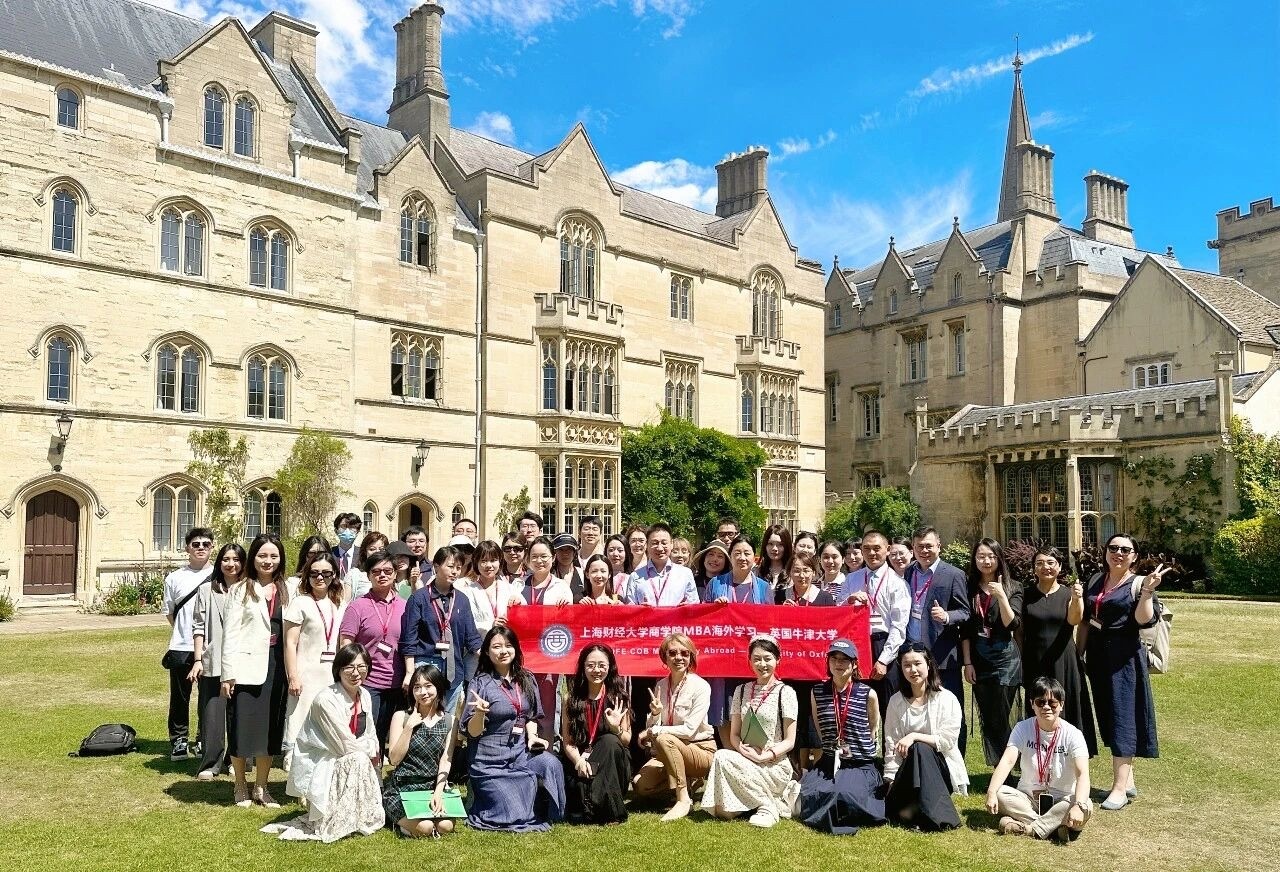
ENThe overseas study elective course for MBA and EMBA students AI and the Future of Productivity: Innovation in Business Leadership, offered by the College of Business of Shanghai University of Finance and Economics (SUFE), was successfully delivered at three world‑renowned institutions of higher education: the University of Oxford, the University of Cambridge, and University College London (UCL).
From the centuries‑old lecture halls of the University of Oxford to the academic halls of the University of Cambridge, and from Amazon’s intelligent sorting center to the forefront of AI innovation represented by the China‑Britain Artificial Intelligence Association (CBAIA), this in‑depth journey spanning academia and business practice encouraged students to rethink the technological foundations of “new quality productive forces” and the humanistic boundaries of “business leadership” at a pivotal moment when AI is reshaping the global business landscape.
The University of Oxford is renowned for its collegiate and tutorial systems. Here, dialogue centers on continuous questioning and critical thinking. Accustomed to exchanging and challenging perspectives through case discussions, the students gained a deeper appreciation of the importance of critical thinking, dialogue, and continuous inquiry in MBA education. What constitutes the most valuable outcome of learning: accumulating knowledge or shaping one’s way of thinking? In the age of AI, when knowledge is more accessible than ever, the ability to think independently, cross‑cultural awareness, and a commitment to lifelong learning together form the core competencies of business leaders.
Exploring how AI is reshaping business processes, the Oxford sessions proceeded step‑by‑step from technological breakthroughs to practical applications. The professor emphasized that the key to implementing AI lies not only in the technology itself, but also in “explainability.” Only AI that is understandable and trustworthy can be truly integrated into business decision‑making. For MBA students, this presented an opportunity to re‑examine business logic and organizational transformation, as well as sustained reflection on how technology can create real‑world value.
As the course progressed, a central question emerged: how can AI evolve from a technological tool into a strategic asset for businesses? The pace of technological advancement has far exceeded expectations, yet the true value of AI in business depends on whether managers can strike the right balance between technological innovation, organizational transformation, and risk governance. Technology itself is not the end goal. Ensuring that AI truly serves people should remain a guiding principle throughout the business decision‑making process. Guided by this insight, students drew on their own industry experience to develop a more concrete understanding of how AI could be applied within their respective business contexts.
While growth strategy addresses how to leverage AI to drive business, sustainable operations address how underlying systems can support that growth. At the University of Cambridge, the course started with the concept of “delayed differentiation” and explored how companies can adopt more agile processes to balance operational efficiency with lean inventory management. AI is shifting manufacturing away from mass production toward a new paradigm of intelligent, personalized, and sustainable production. How to balance efficiency and resilience amid uncertainty was a key takeaway from the study tour—and a critical challenge that business leaders must confront in the age of AI.
“We do not see things as they are; we see them through the lens of our own culture.” This perspective, introduced in the Global Business Communication class at UCL, prompted students to re‑examine communication and collaboration in their daily work. At the heart of cross‑cultural competence is recognizing that one’s own cultural perspective is not the only valid viewpoint. Toward the end of the course, the principle of “seeking common ground while respecting differences” resonated strongly with the students. Understanding cultural differences, building trusting relationships, and fostering consensus within diverse teams are precisely the core elements of human leadership that AI is unlikely to replace. Beyond its technological dimensions, this insight brought genuine humanistic warmth to the course.
Knowledge and action go hand in hand: knowledge is the starting point of action, and action brings knowledge to fruition. Stepping out of the classroom, students visited Amazon’s Oxford sortation center to witness real‑world AI applications in logistics. From intelligent sorting and real‑time scheduling to data‑driven operations and human‑machine collaboration, concepts covered in class became tangible on site. What left the deepest impression was Amazon’s consistent focus on people amid its technology deployments. As one student observed, Amazon’s sorting center functions more like an intelligent ecosystem where algorithms and humans coexist and collaborate.
Moving from the classroom to the financial sector, students visited the City of London, met with representatives from the China‑Britain Artificial Intelligence Association, and attended the London Finance Forum hosted by the association. Under the theme “Financial Infrastructure, AI and Markets,” association experts shared multi‑faceted insights covering the evolution of traditional financial systems, AI‑driven transformation in the financial industry, and cutting‑edge applications in quantitative trading and cryptocurrency forecasting. Throughout the sessions, students listened attentively and engaged actively in discussions, gaining a more comprehensive and forward‑looking understanding of real‑world AI adoption in finance, associated risks and challenges, and viable pathways for AI governance.
After several days of classes and site visits, the study tour drew to a close. Building on classroom insights and on‑site observations, student teams delivered compelling presentations on “AI Empowering New Quality Productive Forces.” Presentation topics included AI‑driven business growth, digital communication, transformational leadership, and responsible AI. Ranging from technology implementation to strategic planning, and from organizational change to reflections on human values, students translated classroom theory into systematic business insights and delivered high‑quality outputs.
Liang Lu | EMBA, 2025 CohortAt Britain’s universities, knowledge and action converged. From the historic lecture halls of Oxford and Cambridge to UCL’s modern classrooms, and from cutting‑edge practice at Amazon’s logistics center to global perspectives on cross‑cultural communication, this study tour prompted me to rethink my management approach. Walking through these centuries‑old institutions, I experienced the convergence of historical depth and the pulse of modern business. Even more valuable was the time spent alongside my classmates abroad. Intellectual exchanges in class, conversations along the River Cam, and shared laughter over meals all deepened our mutual understanding and trust. This journey was truly rewarding. It broadened my international perspective and inspired deeper reflection to inform my future management practice.
Chen Xi | MBA, 2024 Cohort, W1 ClassA week of study at Oxford brought the saying “learning never ends” to life. There were always more books in the library than I could read, and always classmates more focused in class than I was. Fresh insights into AI commercialization, the redesign of sustainable operations, shifts in cross‑cultural communication perspectives, and every in‑class inquiry continuously pushed me beyond my existing cognitive boundaries. What moved me most was realizing that some people truly live the kind of life I aspire to: thinking and debating within historic colleges, and exploring the boundaries of the world at a measured pace. At that moment, a seed was planted in my mind: one day I must bring my daughter here. Not to make her into a certain kind of person, but to show her that the world is far bigger than textbooks suggest, and that dreams can be concrete and vivid.
Yu Jinshu | MBA, 2024 Cohort, W1 ClassI was honored to participate in SUFE’s 2026 MBA UK study tour and visit Oxford, the “City of Dreaming Spires”. Without boundary walls separating the university from the city, Oxford and its university are seamlessly integrated. Centuries of history are quietly inscribed upon its grey stone walls, creating an overwhelming sense of heritage. Our itinerary was rich and thought‑provoking. Beyond in‑depth coursework at Oxford, Cambridge and UCL, we toured an Amazon logistics center in the UK and observed the operational logic of a world‑class supply chain, seeing management theories put into practice. This experience immersed me in an exceptional academic atmosphere, broadened my horizons and elevated my thinking. My sincere gratitude goes to the SUFE College of Business for its thoughtful arrangements, which allowed us to encounter a broader world through travel. I will carry this inspiration forward and press ahead with greater resolve.
Lu Jingying | MBA, 2024 Cohort, P1 ClassThe moment I received my certificate of completion, I reflected back on our journey: from the packed schedule on our first day in Oxford to our final day, when I was reluctant to depart. I longed to stay longer, to keep learning and absorbing the culture of this centuries‑old seat of learning. Courses on artificial intelligence, sustainable operations, global business communication and other subjects brought me tremendous benefit. Going forward, I will approach work and life from new perspectives, with greater openness and empathy, building trust amid differences and continuing to grow through exchange.
“The best part of the journey has been taking the learnings and the network and the experience with me. It's part of me now, part of my identity.”
Li Jianing | MBA, 2024 Cohort, P2 ClassThe Global Business Communication course left the deepest impression on me. The professor’s discussion of “seeking common ground while respecting differences” provides a valuable principle for working in multinational environments. During class, I asked the professor how one can gently and tactfully point out others’ misconceptions within cross‑cultural contexts. The professor’s reply was illuminating: while respecting cultural differences is essential, one need not make concessions merely for superficial harmony. This trip not only expanded my theoretical knowledge but also reshaped my mindset for cross‑cultural communication. The distinct academic ethos of each institution — from Oxford’s rigor to UCL’s openness — gave me a renewed understanding of learning itself.
Xia Yizhe | MBA, 2024 Cohort, W2 ClassAt Oxford, I learned at the cutting edge: AI lectures stretched my cognitive boundaries and demonstrated just how fast technology is evolving. I immersed myself in timeless charm, wandering among Gothic buildings and cobblestone streets, feeling the calm accumulated over centuries. I also engaged in inner reflection. Amid the interplay of rapid technological change and timeless tranquility, I realized: technology is a tool empowering growth, not a shackle weighing us down. True growth means embracing innovation and keeping pace with the times, while preserving inner peace and composure in our fast‑moving era.
Yuan Feng | MBA, 2024 Cohort, W2 ClassWhen AI can conduct data analysis, manage workflows and even generate trend forecasts, and when machines outperform humans in efficiency and precision, where lies human value? Questions raised in class found answers by the end of the study tour: AI can replicate workflows and optimize technologies, yet it cannot possess human warmth, empathy, creative thinking or steadfast conviction. It can handle standardized tasks, but cannot deliver management decisions infused with human compassion. This journey taught me that life’s pursuit should not stop at technical efficiency; instead we ought to return to humanity’s unique strengths: creative thinking, humanistic values and a strong sense of responsibility.
As algorithms become the language of business and computing power redefines the boundaries of productive forces, leaders require not only profound knowledge but also vision to steer transformation. Insights from “AI‑Enabled New Quality Productive Forces” will exert a lasting influence on every student’s business practice. We return home so that we may set off anew. The MBA/EMBA programs of the College of Business at Shanghai University of Finance and Economics will continue to implement its internationalization strategy, cultivating a new generation of business leaders equipped with AI literacy, global vision and humanistic care. When we embark on new journeys in the future, AI may have thoroughly transformed our world. Still, SUFE’s motto — To pursue moral and academic excellence in service of the country and society — will always guide us: stay true to the essence of business amid waves of technological change, and uphold humanistic warmth.

Two National Level Foreign Expert Platforms Established at College of Business of Shanghai University of Finance and Economics
The 6th SUFE Workshop on Marketing Research Successfully Held
2026 Overseas Study Tour | AI Empowering New Quality Productive Forces: College of Business MBA/EMBA UK Study Tour Concludes Successfully
2026 SUFE AI + Operations Workshop Successfully Held