
 EN
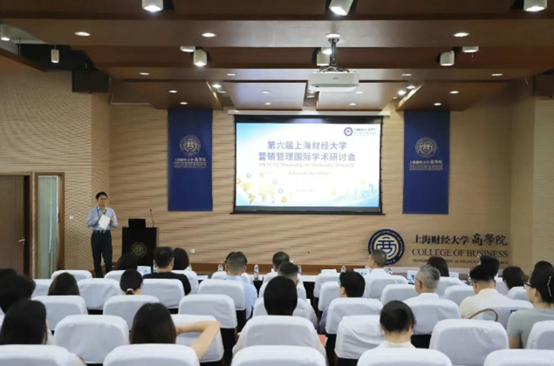
The 6th SUFE Workshop on Marketing Research was held at Shanghai University of Finance and Economics. Hosted by the Department of Marketing at the College of Business of Shanghai University of Finance and Economics, the workshop aimed to bring together leading scholars, industry practitioners, and young scholars in the field of marketing to jointly discuss frontier research and theoretical innovation in marketing management.
Professor Sun Qi, Associate Dean of the College of Business and Head of the Department of Marketing at Shanghai University of Finance and Economics, welcomed and thanked the attending experts, scholars and students. He noted that as the workshop host, the Department of Marketing aims to provide a cooperation‑and‑exchange platform for colleagues engaged in marketing teaching and research. He expressed the hope that the workshop would help young faculty members and doctoral students enhance their research capabilities.
I. Morning Academic Presentations by Invited Guests
Professor Li Hui, The University of Hong Kong
Presentation Title: The Ripple Effect of Platform Quality Controls in a Submarket: Evidence from a Secondhand Marketplace
Using the “Premium Selection” submarket for secondhand smartphones on the Zhuanzhuan marketplace as the empirical setting, Professor Li examined the heterogeneous effects of platform quality control mechanisms on sellers. Existing research has paid limited attention to the long‑term impacts of quality control on participating sellers or to the spillover effects on non‑participating sellers. Based on a natural experiment on the platform, the analysis finds that platform quality inspection and other control measures not only bring immediate gains to merchants but also exert long‑term positive sustained effects. Moreover, these measures generate a U‑shaped spillover effect on non‑participating sellers via two channels: the competition effect and the perceived‑quality enhancement effect. Findings further indicate that when the adoption rate of the platform's premium‑selection program rises to a sufficiently high level, ordinary sellers can achieve net benefits, offsetting the competitive pressure posed by leading sellers. This study offers important theoretical implications for platform‑governance strategies and antitrust‑related policies.
Associate Professor Yan Dengfeng, New York University Shanghai
Presentation Title: The Impact of Platform Metric Design on User Engagement
Using the WeChat platform rule that changes article view counts from 100,000 to the "100K+" label as the research setting, the study examined how platform metric design influences user engagement. Employing a regression discontinuity design, the study investigated the effect of this display rule on users' likelihood of clicking the "like" button. The results show that once an article surpasses the 100,000‑view threshold, its like rate increases significantly, indicating that the “100K+” label serves as a simple heuristic for users to infer an article's popularity and quality. Further tests based on the motivation‑ability‑opportunity framework demonstrate that the effect of the “100K+” label is stronger when users have limited motivation to read the article in depth, lack sufficient time or cognitive resources for information processing, or when the article lacks other quality signals such as the “Original” badge. The study demonstrates that the precision of platform data display directly changes users' content consumption behavior, enriching research on platform metrics design and user engagement.
Assistant Professor Jiang Zhenling, University of Pennsylvania
Presentation Title: Estimating Treatment Effects under Algorithmic Interference: A Structured Neural Networks Approach
This study focuses on the causal inference challenges in experiments on platform recommendation algorithms. In advertising and content distribution settings, treatment and control group content share the same traffic pool, creating "algorithmic interference" caused by competition for exposure. Traditional mean‑comparison methods can produce severe estimation bias and may potentially mislead platforms into launching inefficient recommendation algorithms. The paper proposes a structured neural network model that integrates machine learning with a semiparametric selection model to recover the underlying exposure mechanism of recommendation algorithms and estimate the true treatment effect of deploying a new algorithm at scale. Validated with large‑scale experimental data from WeChat Channels, this method yields estimates comparable to the benchmark derived from a two‑sided randomized experiment free of algorithmic interference. It substantially outperforms conventional evaluation approaches and delivers a new methodology for platform A/B testing and the assessment of recommendation algorithms.
II. Afternoon Academic Presentations by Invited Guests
Associate Professor Jia He, The University of Hong Kong
Presentation Title: The Aesthetics of Product Ratings
Previous research on product ratings has focused only on rating values while overlooking the visual and aesthetic attributes of star ratings and bar ratings. This study focuses on how visual features such as the placement, orientation, and form of rating graphics influence consumer choice. The core mechanism is that star bars filled from left to right naturally provide a rightward visual cue, causing consumers' attention to shift along the visual cue and making them more likely to choose products displayed on the right. Ten experiments collectively corroborate this conclusion, and mediation analyses confirm that visual orientation constitutes the core driving mechanism behind the effect. The study expands the research dimensions of the rating literature and confirms that subtle visual design elements in rating interfaces can significantly influence consumer purchase decisions, offering practical guidance.
Assistant Professor Zhu Yuting, National University of Singapore
Presentation Title: The Power of Linear Programming in Sponsored Listings Ranking: Evidence from a Large‑Scale Field Experiment
Sponsored listings on e‑commerce platforms are a major source of platform revenue, and ad ranking must balance advertising revenue with product recommendation relevance and user experience. This paper develops a linear‑programming ranking algorithm to maximize the platform’s total revenue, consisting of both organic‑traffic transaction revenue and advertising revenue, while setting product relevance as a hard minimum constraint. To satisfy the computational requirements of high‑concurrency online platforms, the algorithm adopts a dual‑bisection optimization algorithm to enable fast real‑time computation. Large‑scale field‑experiment evidence shows that the proposed approach substantially outperforms industry‑standard ranking benchmarks, lifting both platform revenue and product‑matching quality. Its optimization gains are most salient when revenue maximization comes into sharp conflict with user‑experience preservation.
Associate Professor Yan Li, University of Macau
Presentation Title: Selling Triggers Buying on Peer‑To‑Peer Resale Platforms
Existing research on peer‑to‑peer marketplaces typically treats users' roles as buyers and sellers separately, overlooking the interactions that arise when users switch between these roles. This study introduces the concept of the "resale‑to‑purchase effect," demonstrating that users who list items for sale on a resale platform become significantly more likely to make purchases on the same platform. The underlying logic is that listing secondhand goods for sale increases users' perceived self‑other overlap with other sellers on the platform, enhancing their overall trust in platform merchants through social projection and ultimately promoting purchase behavior. The study contributes to the literature on two‑sided platforms, online trust, and sustainable consumption. From a practical perspective, the findings suggest that platforms can boost buyer‑side activity by encouraging users to list idle items for resale, thereby activating potential buyers and building a virtuous cycle of user engagement, transaction volume, and user retention.
III. Doctoral‑Student Roundtable
During the doctoral‑student roundtable, invited speakers and PhD participants held in‑depth academic exchanges on frontier topics in marketing and quantitative‑empirical methodologies, helping young researchers broaden their research horizons.
This workshop assembled scholars, industry practitioners and students from numerous universities at home and abroad. It established a high‑level academic‑exchange platform to facilitate intellectual interactions and spark new research ideas. Participants commented that the frontier‑research outputs shared at the workshop provided meaningful implications for marketing theory as well as practical platform operations. They expressed the wish that such academic exchanges and collaborations would continue.


Two National Level Foreign Expert Platforms Established at College of Business of Shanghai University of Finance and Economics
The 6th SUFE Workshop on Marketing Research Successfully Held
2026 Overseas Study Tour | AI Empowering New Quality Productive Forces: College of Business MBA/EMBA UK Study Tour Concludes Successfully
2026 SUFE AI + Operations Workshop Successfully Held