 EN
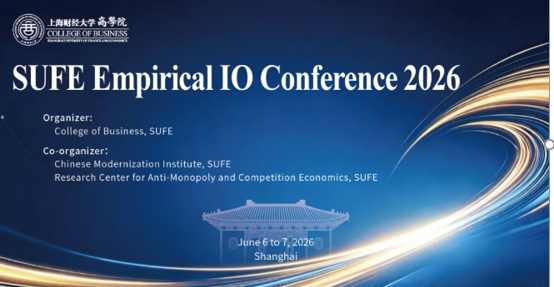
ENThe 2026 SUFE Empirical Industrial Organization Conference was successfully hosted by the College of Business, Shanghai University of Finance and Economics (SUFE). Co-organizers of the event were the Institute of Chinese Modernization Studies and the Center for Antitrust and Competition Economics, both affiliated with SUFE. Scholars from universities and research institutions across the globe gathered to exchange insights on cutting-edge research in empirical industrial organization. The conference featured keynote addresses, parallel thematic paper sessions, and dedicated paper discussant panels, showcasing how empirical industrial organization research delivers actionable insights to address real-world economic challenges, support evidence-based policy analysis, and drive advances in theoretical innovation.
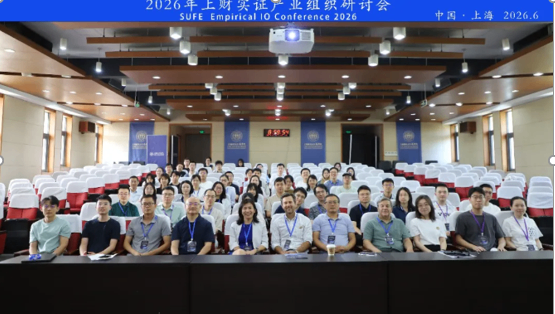
Opening Session
Ju Heng, Head of the Industrial Economics Department at SUFE College of Business and Director of the Center for Antitrust and Competition Economics, delivered the opening remarks. He extended a warm welcome to all attendees and underscored the conference’s vital role in pooling academic expertise, fostering international scholarly dialogue, and advancing the development of industrial organization as a discipline.
The official academic agenda kicked off with the plenary keynote session on the morning of June 6, moderated by Mark J. Roberts from Pennsylvania State University.
Professor Shanjun Li of Stanford University delivered a keynote speech titled The Rise of China’s Electric Vehicle Industry and Its Global Impacts. Moderator Professor Roberts introduced Professor Li as a globally influential scholar whose research spans empirical industrial organization, energy and environmental economics, and transportation economics. Professor Li’s presentation centered on the expansion of China’s electric vehicle sector and its far-reaching global ramifications.
He first clarified that the rapid growth of China’s electric vehicle industry cannot be attributed to policy support alone; instead, it stems from the synergistic interplay of targeted industrial policies, fierce market competition, integrated supply chain advantages, and cumulative manufacturing capacity. Drawing on a structural model incorporating buyer-supplier matching, upstream market competition, and vertical industrial agglomeration, he illustrated that deeper supplier market depth and tighter geographic clustering between upstream and downstream manufacturers jointly reduce component costs, improve supplier-buyer matching quality, and boost on-time delivery reliability.
Toward the end of his talk, Professor Li analyzed tariff and subsidy policy frameworks adopted by Europe and the United States amid growing market penetration by Chinese electric vehicle manufacturers. His work vividly demonstrated the analytical power of empirical industrial organization tools for unpacking competitive dynamics within the new energy sector and evaluating policies designed to advance the green economic transition.
Session 1: Network Effects and Firm Competition
This session explored platform interconnection, heterogeneous product diffusion, and vertical bargaining dynamics within two-sided markets. Presenters included Wu Qi (Peking University), Yu Hao (University of Hong Kong), and Luo Rong (Renmin University of China).
Wu Qi presented Social Network and Product Characteristics Design in the Chinese Kids Smartwatch Market, examining how built-in social networking features shape network effects and reshape competitive landscapes in the children’s smartwatch industry.
Yu Hao presented Heterogeneous Diffusion of Electric Vehicles in China: Demand, Cost, Product Entry, and the Sources of Adoption Growth, quantifying the respective contributions of new product launches, falling battery production costs, and subsidy policies to the nationwide uptake of electric vehicles.
Luo Rong presented Market Size and Vertical Bargaining in Two-Sided Markets: An Application to Shopping Malls, investigating how foot traffic externalities generated by food and beverage tenants alter rental negotiations and strengthen the bargaining power of retail merchants within shopping mall ecosystems.
Discussants for this session were Yu Hao (University of Hong Kong), Zhou Xiaolan (Shandong University), and Li Anran (University of Minnesota).
Session 2: Production and Productivity (Part A)
Held on the afternoon of June 6, this session focused on production organization, collaborative arrangements among competing firms, and market power. Presenters were Hongsong Zhang (University of Hong Kong) and Zheng Honghao (Renmin University of China).
Hongsong Zhang presented Competitive Collaboration: Order Sharing among Competitors, analyzing how order-sharing agreements between rival firms affect sales performance, mitigate demand uncertainty, and improve overall operational outcomes.
Zheng Honghao presented Death by Market Power: The Production-Safety Tradeoff in the Coal Mining Industry, studying how buyer power held by downstream power plants shapes coal mine profitability, safety investment decisions, and occupational fatality risks.
Pan Qingsong (Shandong University) and Hongsong Zhang (University of Hong Kong) served as paper discussants.
Session 3: Regulation, Environment, and Transportation
This session extended empirical industrial organization analysis to regulatory design, environmental governance, and transportation economics. Presenters were Ertian Chen (University College London) and Li Guohao (National University of Singapore).
Ertian Chen presented Carbon Regulation and Competition in the European Airline Industry, evaluating how carbon taxation prompts European airlines to restructure their route networks and measuring the corresponding welfare implications.
Li Guohao presented Distributional Effects of Vehicle Ownership Restrictions, unpacking the spatial equity outcomes of Singapore’s vehicle quota scheme and its Certificate of Entitlement market.
Discussants were Lu Sen (Central University of Finance and Economics) and Xue Qinshu (Shanghai Jiao Tong University).
Session 4: AI and Research in Economics
This afternoon session featured a single standalone presentation. Tao Xuezhen from Shanghai University of Finance and Economics delivered the talk AI Workflow Design in Economic Research. He outlined how AI-powered workflows streamline repetitive empirical research tasks, including data cleaning, code execution, table formatting, and literature organization. Meanwhile, he emphasized that human researchers remain irreplaceable in core scholarly work: formulating research questions, designing credible identification strategies, and addressing ethical considerations in quantitative analysis.
The second plenary keynote session on the morning of June 7 deepened the conference’s academic discourse, moderated by Xiao Mo from the University of Arizona.
Professor Charlie Murry of the University of Michigan delivered a keynote address titled Market Power and Consumer Welfare: Evidence from Long-Run Industry Studies. Moderator Professor Xiao introduced Professor Murry as a preeminent international scholar specializing in empirical industrial organization, market power measurement, consumer welfare evaluation, and automotive industry research.
Professor Murry’s presentation drew on long-term industry data to revisit the link between market power and consumer well-being. Opening with ongoing public debates over antitrust regulation and rising corporate markups, he argued that evaluations of market competition should not rely solely on industry concentration ratios or markup levels. Instead, rigorous analysis must account for industry-specific demand and supply fundamentals, price-setting mechanisms, product quality differentiation, and consumer choice sets.
Using the U.S. new automobile market as a core case study, he showed that despite rising sticker prices and shifting market structures, industry markups have declined over time, accompanied by steady improvements in product quality and manufacturing efficiency—resulting in substantial long-term gains in consumer surplus. He concluded by stressing the critical importance of rigorous model specification and identification strategies, highlighting the unique value of long-run industrial analysis for understanding market power, innovation incentives, and dynamic welfare changes.
Session 5: Digital Economics and Vertical Relationships
This session centered on digital economy ecosystems, platform governance, and vertical market control. Presenters included Xintong Han (Université Laval), Ao Wang (University of Warwick), and Zhonglin Li (National University of Singapore).
Xintong Han presented Less Personalization, More Purchases: Causal Evidence from a Chinese Online Platform, identifying the causal impact of randomized recommendation algorithms on user discovery and transaction volumes on a Chinese subscription creator platform.
Ao Wang presented Ownership and Digital Interoperability: Measurement and Evidence, quantifying digital interoperability within mobile application markets and assessing how shared corporate ownership shapes app usage patterns and competitive advantages.
Zhonglin Li presented Vertical Control and Retail Competition: Evidence from Consumer Battery Industry, exploring how vertical coordination between manufacturers and retailers influences pricing strategies, firm profitability, and consumer welfare in the consumer battery sector.
Discussants were Yuan Zhe (Zhejiang University), Wu Qi (Peking University), and Ertian Chen (University College London).
Session 6: Production and Productivity (Part B)
Taking place on the afternoon of June 7, this session continued discussions on production function estimation, supply constraints, and industrial policy design. Presenters were Pan Qingsong (Shandong University) and Qiu Xincheng (Peking University).
Pan Qingsong presented Identification of Gross Output Production Functions with Nonseparable Productivity, addressing methodological challenges in identifying and estimating gross output production functions when productivity and input factors are non-separable.
Qiu Xincheng presented Price vs. Production Restrictions: China’s Coal Industry, comparing the tradeoffs between taxation and quantity caps as policy tools to mitigate negative externalities in China’s coal sector.
Zheng Honghao (Renmin University of China) and Ce Shi (Chinese University of Hong Kong) provided critical commentary on the papers.
Session 7: Health Economics
The conference’s final session focused on sorting mechanisms, intermediation, and market design within healthcare markets. Presenters were Han Ng (Academia Sinica, Taiwan) and Li Anran (University of Minnesota).
Han Ng presented Breaking Bad Opioid Sorting, analyzing how patients’ doctor selection based on prescription preferences drives disparities in opioid prescriptions, excessive high-dose medication, and the effectiveness of pharmaceutical regulatory policies.
Li Anran presented Going for Broker? Intermediation in Health Insurance Markets, weighing the welfare tradeoffs of broker commissions in health insurance markets, including consumer steering behavior, insurance network expansion, and aggregate social welfare outcomes.
Discussants were Shengmao Cao (Northwestern University, U.S.) and Wang Yanfei (Renmin University of China).
Conference Closing Remarks
The two-day 2026 SUFE Empirical Industrial Organization Conference concluded successfully after two full days of intensive academic exchange. Centered on empirical industrial organization methodology, the conference spanned diverse applied research fields including new energy vehicles, digital economics, firm productivity, environmental regulation, artificial intelligence, and health economics. It showcased continuous methodological advances in data processing, structural modeling, and causal identification within the field, while reflecting scholars’ shared focus on industrial transformation, public policy design, and social welfare optimization.
The conference fully demonstrated that empirical industrial organization has evolved into an indispensable analytical framework for evaluating technological shocks, designing competitive market systems, and assessing regulatory impacts. The keynote speeches delivered comprehensive, forward-looking perspectives; parallel session papers featured rigorous, grounded empirical analysis; and panel discussions featured open, constructive academic dialogue.
Beyond academic exchange, the conference established a high-level, open research platform for scholars worldwide. It also created valuable opportunities for early-career academics to broaden their research horizons and generate new research ideas through cross-institutional dialogue.

Two National Level Foreign Expert Platforms Established at College of Business of Shanghai University of Finance and Economics
The 6th SUFE Workshop on Marketing Research Successfully Held
2026 Overseas Study Tour | AI Empowering New Quality Productive Forces: College of Business MBA/EMBA UK Study Tour Concludes Successfully
2026 SUFE AI + Operations Workshop Successfully Held